
CHEMOFAST offers different cartridge systems with specific technical characteristics and applications – from standard coaxial solutions to innovative systems such as the peeler cartridge.
Cartridge technologies are a core component of our chemical anchoring systems. They enable precise, safe and efficient application of two-component materials and are designed to meet a wide range of requirements.
Peeler Cartridge
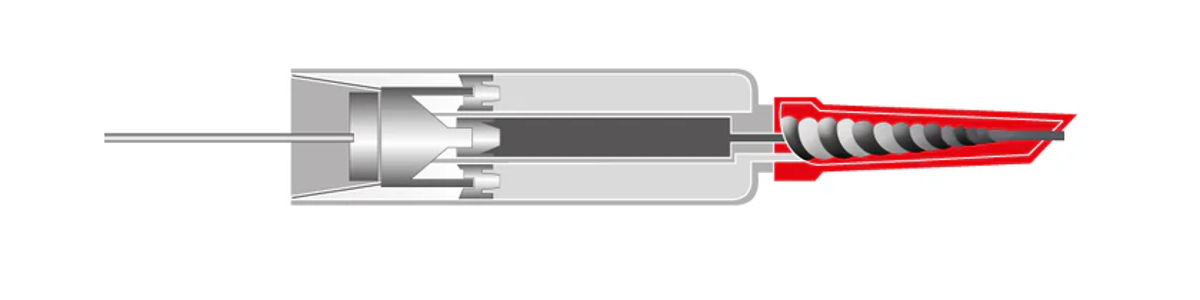
This 2-component coaxial cartridge can be dispensed using a standard 1-component gun (caulking gun) by means of a patented cutting plunger. The cutting plunger, located inside the cartridge, is secured behind the two pistons with a clip.
During dispensing, the gun's thrust plate drives the cutting plunger—along with the downstream A and B pistons—in an axial direction. As it advances, the cutting plunger splits the B-tube—specifically the section that has been emptied following the forward movement of the B-piston—into two halves. These two halves of the B-tube are guided along the inner wall of the A-tube through two semi-circular openings in the cutting plunger, ensuring that the dispensing process is never impeded, nor is the dispensing pressure increased, at any point.
Advantages:
- Easy dispensing possible using a standard gun
- Correct mixing ratio guaranteed throughout the entire use of the cartridge
Coaxial Cartridge
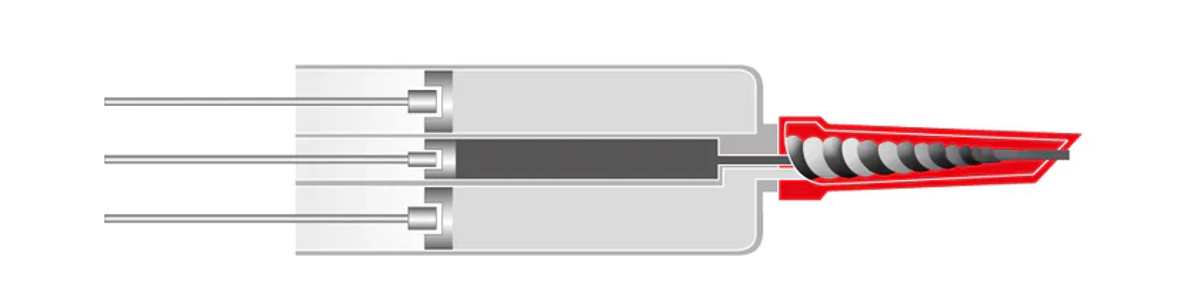
This type of cartridge consists of a cylindrical outer tube and a cylindrical inner tube situated within it, creating two separate chambers in a "tube-in-tube" (coaxial) arrangement; these chambers are filled with Component A (in the outer tube) and Component B (in the inner tube), and each is individually sealed with a piston.
The 2-component cartridge is dispensed using a specialized dispensing gun fitted with a static helical mixer. This specialized gun—the dimensions of which are precisely matched to the diameter and volume of the 2-component cartridge—features a plunger mechanism with two thrust plates, designed to accommodate the cartridge's coaxial "tube-in-tube" construction.
During the dispensing process, the gun's plunger mechanism advances axially into both the outer and inner tubes of the cartridge simultaneously, with one thrust plate pressing against the piston in the outer tube and the second against the piston in the inner tube. In this manner, Components A and B—contained within the outer and inner tubes, respectively—are simultaneously expelled from the cartridge and homogeneously mixed as they pass through the static helical mixer screwed onto the cartridge.
Flexible Film Cartridge
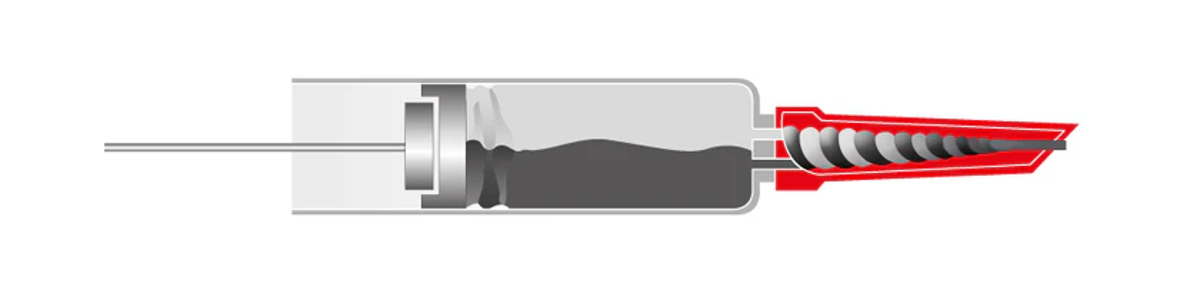
The 2-component flexible film cartridge can be dispensed using a standard 1-component gun (caulking gun), just like a silicone cartridge. In this type of cartridge, a dual-chamber flexible film containing components A and B is housed within a standard single-component cartridge shell.
After unscrewing the cap, the clipped end of the flexible film protrudes from the cartridge neck and must be cut open prior to use.
Advantages:
- Easy application using a standard gun
- Low extrusion resistance
Side-by-Side Cartridge
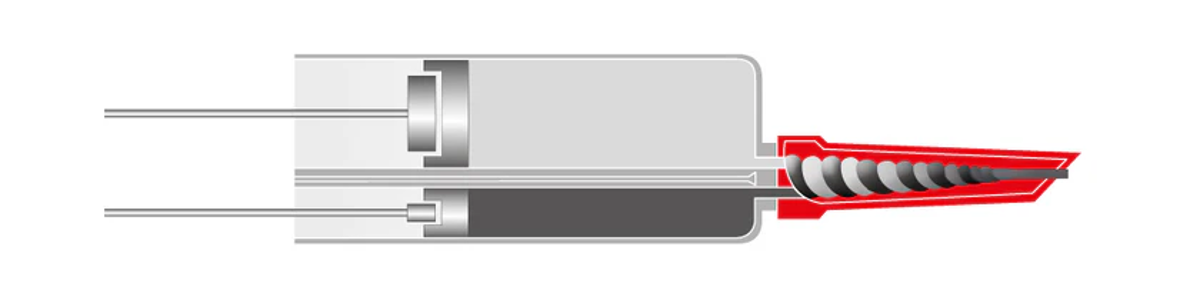
This type of cartridge consists of two cylindrical tubes arranged side-by-side, connected to one another, and converging into a coaxially designed headpiece (featuring a "tube-within-a-tube" construction). Component A is contained in one tube (the A-tube), while Component B is located in the second tube (the B-tube); both tubes are sealed with corresponding pistons.
The 2-component cartridge is dispensed using a specialized dispensing gun, extruding the contents through a static helical mixer. This specialized dispensing gun—the dimensions of which are specifically matched to the diameter and volume of the 2-component cartridge—features a linkage mechanism designed to align with the parallel, "side-by-side" arrangement of the cartridge's A- and B-tubes, with thrust plates positioned at the ends of the linkage.
During the dispensing process, the gun's linkage advances axially into both the A-tube and the B-tube simultaneously; this action causes Components A and B—contained within their respective tubes—to be extruded from the cartridge concurrently and homogeneously mixed as they pass through the static helical mixer screwed onto the cartridge.
Peeler Cartridge
This 2-component coaxial cartridge can be dispensed using a standard 1-component gun (caulking gun) by means of a patented cutting plunger. The cutting plunger, located inside the cartridge, is secured behind the two pistons with a clip.
During dispensing, the gun's thrust plate drives the cutting plunger—along with the downstream A and B pistons—in an axial direction. As it advances, the cutting plunger splits the B-tube—specifically the section that has been emptied following the forward movement of the B-piston—into two halves. These two halves of the B-tube are guided along the inner wall of the A-tube through two semi-circular openings in the cutting plunger, ensuring that the dispensing process is never impeded, nor is the dispensing pressure increased, at any point.
Advantages:
- Easy dispensing possible using a standard gun
- Correct mixing ratio guaranteed throughout the entire use of the cartridge
Coaxial Cartridge
This type of cartridge consists of a cylindrical outer tube and a cylindrical inner tube situated within it, creating two separate chambers in a "tube-in-tube" (coaxial) arrangement; these chambers are filled with Component A (in the outer tube) and Component B (in the inner tube), and each is individually sealed with a piston.
The 2-component cartridge is dispensed using a specialized dispensing gun fitted with a static helical mixer. This specialized gun—the dimensions of which are precisely matched to the diameter and volume of the 2-component cartridge—features a plunger mechanism with two thrust plates, designed to accommodate the cartridge's coaxial "tube-in-tube" construction.
During the dispensing process, the gun's plunger mechanism advances axially into both the outer and inner tubes of the cartridge simultaneously, with one thrust plate pressing against the piston in the outer tube and the second against the piston in the inner tube. In this manner, Components A and B—contained within the outer and inner tubes, respectively—are simultaneously expelled from the cartridge and homogeneously mixed as they pass through the static helical mixer screwed onto the cartridge.
Flexible Film Cartridge
The 2-component flexible film cartridge can be dispensed using a standard 1-component gun (caulking gun), just like a silicone cartridge. In this type of cartridge, a dual-chamber flexible film containing components A and B is housed within a standard single-component cartridge shell.
After unscrewing the cap, the clipped end of the flexible film protrudes from the cartridge neck and must be cut open prior to use.
Advantages:
- Easy application using a standard gun
- Low extrusion resistance
Side-by-Side Cartridge
This type of cartridge consists of two cylindrical tubes arranged side-by-side, connected to one another, and converging into a coaxially designed headpiece (featuring a "tube-within-a-tube" construction). Component A is contained in one tube (the A-tube), while Component B is located in the second tube (the B-tube); both tubes are sealed with corresponding pistons.
The 2-component cartridge is dispensed using a specialized dispensing gun, extruding the contents through a static helical mixer. This specialized dispensing gun—the dimensions of which are specifically matched to the diameter and volume of the 2-component cartridge—features a linkage mechanism designed to align with the parallel, "side-by-side" arrangement of the cartridge's A- and B-tubes, with thrust plates positioned at the ends of the linkage.
During the dispensing process, the gun's linkage advances axially into both the A-tube and the B-tube simultaneously; this action causes Components A and B—contained within their respective tubes—to be extruded from the cartridge concurrently and homogeneously mixed as they pass through the static helical mixer screwed onto the cartridge.
Adolf Würth GmbH & Co. KG collects and processes the personal data provided in the form in order to process the requested request for you. Please note the marking of the mandatory fields on the forms. The legal basis for this processing of the mandatory data is Art. 6 (1) (b) GDPR, implementation of a pre-contractual measure. The processing of the data voluntarily provided by you is carried out on the basis of Art. 6 (1) (f) GDPR. According to this, processing is permissible that is necessary to protect our legitimate interests. Our legitimate interest is to have contact with you, our customers, to improve the quality of our advice and to be able to contact you more easily if you have any questions. The data collected will only be stored by us for as long as it is necessary to process your request and to contact you. After that, they will be deleted.
Additional data protection information, in particular on your rights to information, correction, deletion, restriction of processing, objection and complaint, can be found in our privacy policy.